Earl Axman
The Plot Against AmericaEarl Axman is Philip’s adventurous older friend, stamp mentor, and partner in clandestine explorations. In the months when Philip feels his family and country slipping away from him, Earl offers an intoxicating model of boyhood independence: stealing, roaming, and following strangers. Their excursions culminate in a frightening encounter that Earl abruptly flees; within weeks, he and his household are gone, leaving their friendship suspended at the edge of an unexplained disappearance.
Identity and Background
Earl is nearly two years older than Philip, and his glamorous parents are divorced. He does not seem to have tried to be a model child, a contrast that matters to Philip, who has grown increasingly irritated with his own dutifulness. With homework that takes little time and only the chore of setting the dinner table, Philip has afternoons free; Earl, whose mother often appears to be out, supplies both company and mischief.
Earl first draws Philip through their shared interest in stamps. Philip spends hours with him poring over Earl’s collection through a magnifying glass, and also peering into the bureau where Earl’s mother keeps her undergarments. The collection is not just a hobby: it is the initial point of attachment between the boys, even as their friendship expands into activities far removed from collecting.
Following Strangers
Earl has already been following men home from work a couple of times a week before Philip joins him. After school, he travels downtown alone, waits near bus stops, boards a bus behind a man he has chosen, and follows him from a distance after they get off. His stated purpose is simply to discover where people live. The journeys carry him beyond Newark, and the freedom to go anywhere becomes part of the attraction; he measures success by how far he can travel and still return before his mother.
The excursions depend on theft. Earl takes bus fare from his mother’s handbags, which he keeps piled in a bedroom drawer. On weekends at his father’s apartment in New York City, he steals from suit pockets and, when musicians from the Casa Loma Orchestra come over to play poker, searches their overcoats while they are in the living room. He hides the coins in a dirty sock at the bottom of his suitcase, then sits in on the afternoon’s stories about performances at the Paramount, the Essex House, and the Glen Island Casino. After the band returns from Hollywood in 1941, Earl passes on what he hears about movie stars to Philip, who repeats the stories to Sandy Roth. Sandy dismisses them and warns Philip that Earl knows too much for a little kid.
Philip’s growing eagerness for these exploits reflects a larger break in his sense of childhood. Alone after school, he has begun to mutter in bed, “Now let's do something awful,” an invitation he associates with Earl’s habit of proposing more daring behavior. Following people gives that impulse a form: a private game of trespass that lets the boys imagine themselves beyond parental oversight and ordinary limits.
The Final Excursion
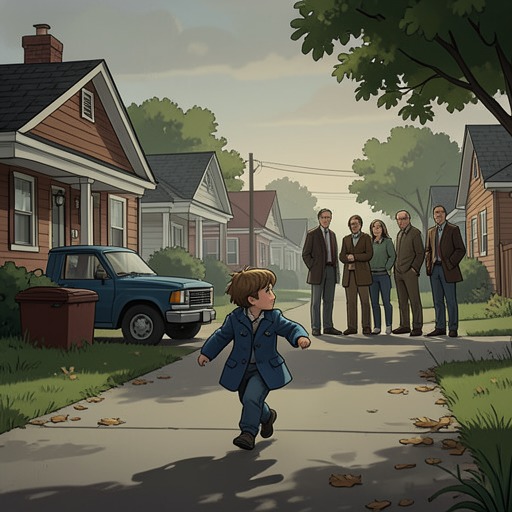
A few days before Christmas vacation, Earl and Philip board a bus behind a man carrying two department-store bags stuffed with gifts and decorated in red and green. The man travels past Hillside and into Elizabeth, getting off near a cemetery. The boys follow in the deepening winter twilight, dressed like other local schoolchildren in hooded coats, wool mittens, corduroy trousers, and rubber galoshes. Confident in their practiced concealment, they have come to think of themselves as an “invincible duo”; this time, however, their trailing is less skillful than they believe.
The man realizes that boys are following him and calls to them in a friendly manner. He says it is getting dark and cold, and invites them inside for cocoa, cakes, animal crackers, and marshmallows to toast. When Philip looks to Earl for a decision, Earl is already heading back toward Newark. He shouts, “Run for it,” then tells Philip to beat it because “it's a fairy!” The account establishes Earl’s alarm and sudden flight, but does not explain the man’s intentions beyond his invitation.
Departure and Narrative Significance
The final trip is followed by the abrupt dissolution of Earl’s household. Ten days after the outing, Mrs. Axman suffers a nervous breakdown and is taken away in an ambulance in the middle of the night. Soon after, on New Year’s Day 1942, Earl’s father takes him away with the stamp collection. Later in January, a mover’s truck removes the household furnishings, including the bureau that had figured in Philip’s childhood curiosity. No one on Summit Avenue sees the Axmans again.
Earl’s importance lies in the particular freedom he makes imaginable to Philip: not abstract rebellion, but stolen fares, distant bus rides, strangers’ doorways, and secrets kept from adults. That freedom is exhilarating while it lasts, yet the boys’ final pursuit ends not in mastery but in retreat, and Earl’s departure soon makes their partnership unreachable. In Philip’s recollection, the abrupt disappearance of a friend gives childhood mischief a precarious edge: the world beyond the home can be entered, but it cannot be made safe or held in place.